In July 2012, Quinn DuPont—at the Information Science department at University of Toronto—ran a “Cracking the Agrippa Code” contest offering hackers “every William Gibson book ever published (except Agrippa)” for solving the mystery of how the code on Agrippa’sdisk actually worked to scroll Gibson’s poem up the screen and then, famously, “encrypt” it forever. The contest produced surprising discoveries.
“Cracking the Agrippa Code” Contest
— Archival Copies (original posts here) CC BY-NC 3.0 —
Agrippa cryptography algorithm implemented in Javascript by Ayal Ryger. Can be used to decrypt the pre-encrypted text of Gibson’s poem; or to encrypt any plain text. (Only the decryption function was present on Agrippa’s disk to act on the pre-encrypted poem. The encryption function in this Javascript implementation was reverse engineered by Ryger.)
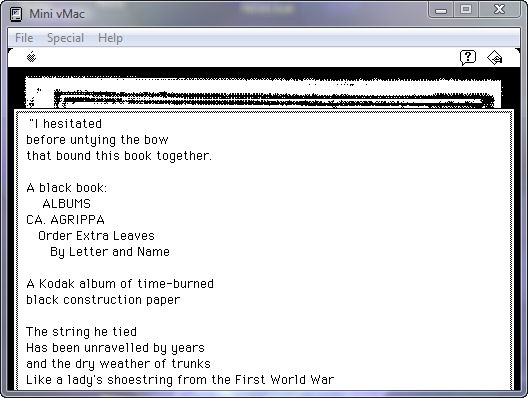
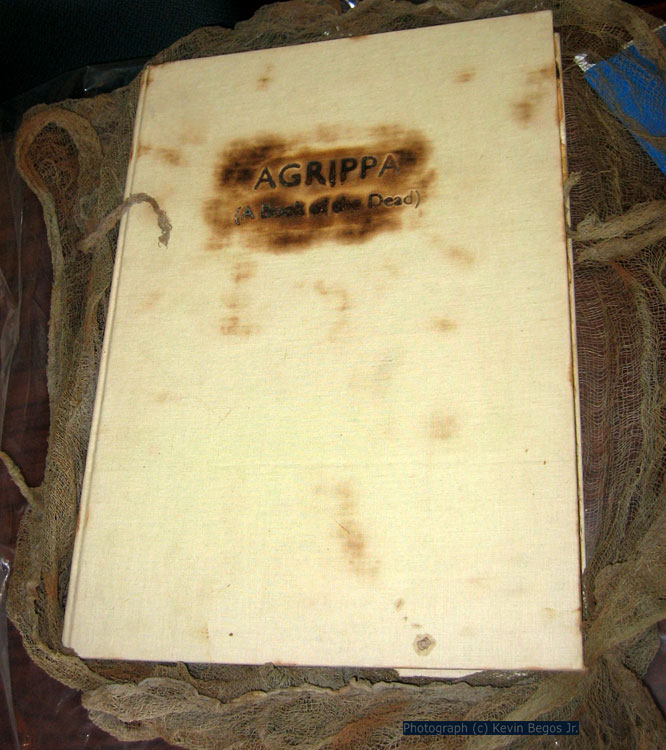
I hesitated
before untying the bow
that bound this book together.
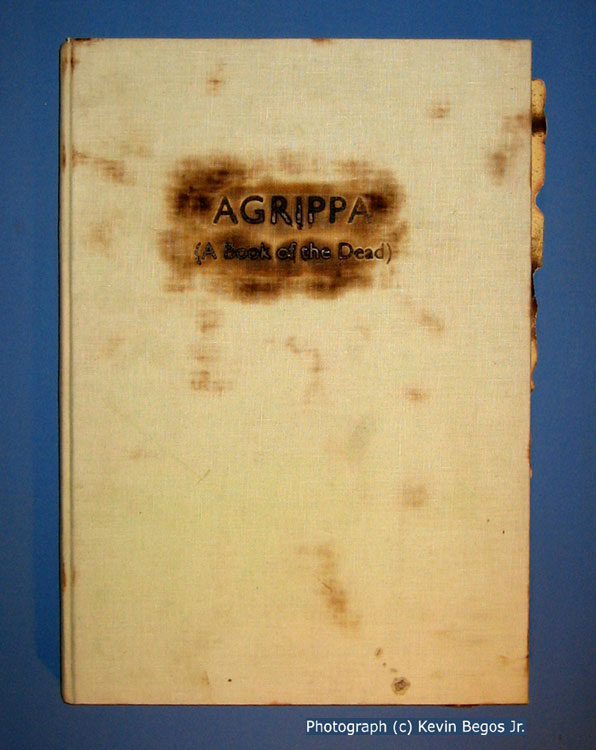
A black book:
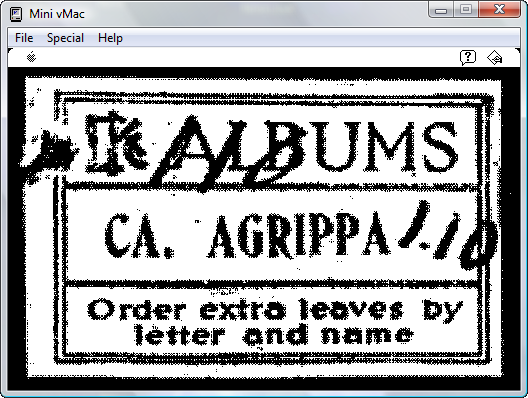
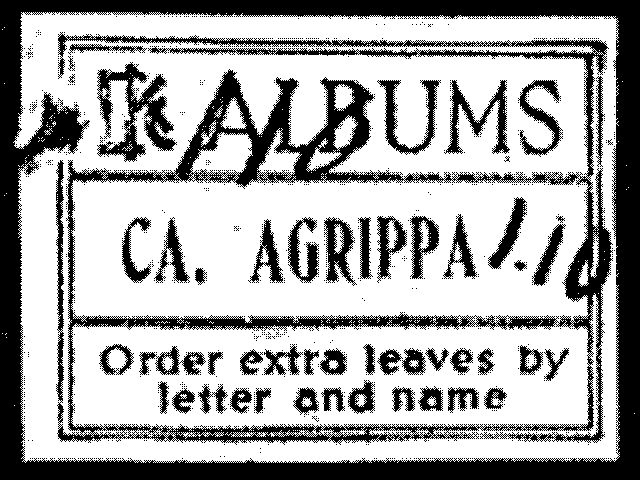
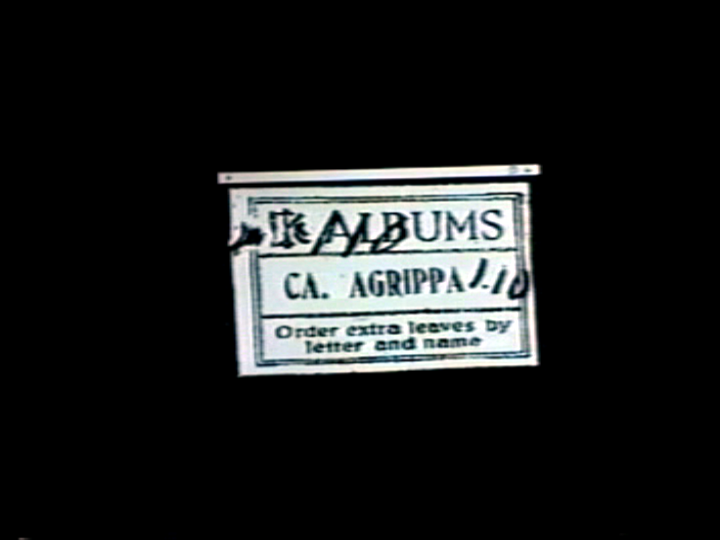
ALBUMS CA. AGRIPPA
Order Extra Leaves By Letter and Name
A Kodak album of time-burned
black construction paper
The string he tied
Has been unravelled by years
and the dry weather of trunks
Like a lady’s shoestring from the First World War
Its metal ferrules eaten by oxygen
Until they resemble cigarette-ash
Inside the cover he inscribed something in soft graphite
Now lost
Then his name
W.F. Gibson Jr.
and something, comma,
1924
Then he glued his Kodak prints down
And wrote under them
In chalk-like white pencil:
“Papa’s saw mill, Aug. 1919.”
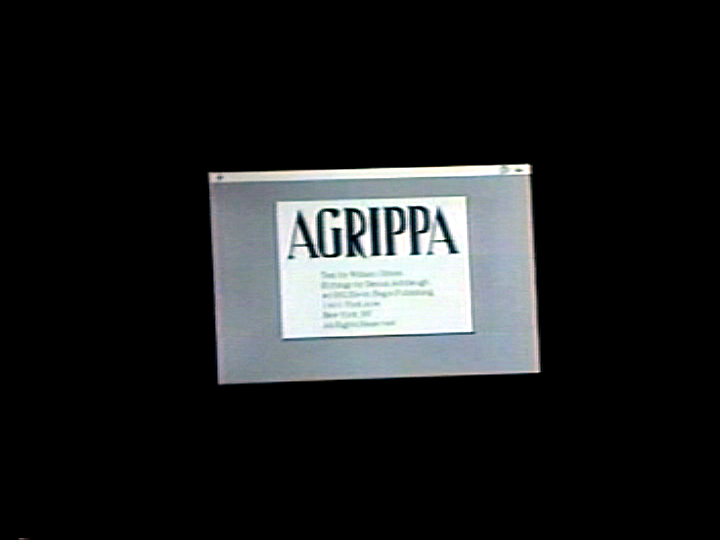
Item #D51. Video capture of a “run” of William Gibson’s “Agrippa” poem made from playing a disk-image (bit-level) copy of original 1992 Agrippa diskette.
Source: original 1992 Agrippa3.5″ diskette, 1.4 Mb, loaned by collector Allan Chasanoff.
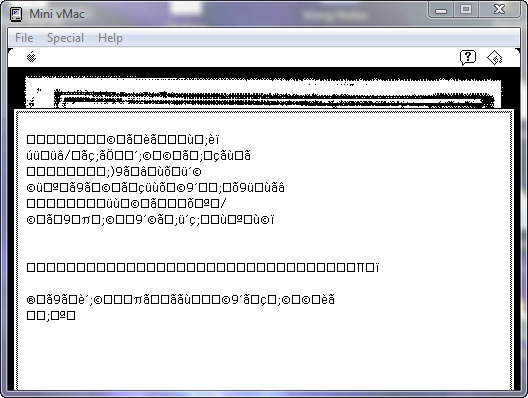
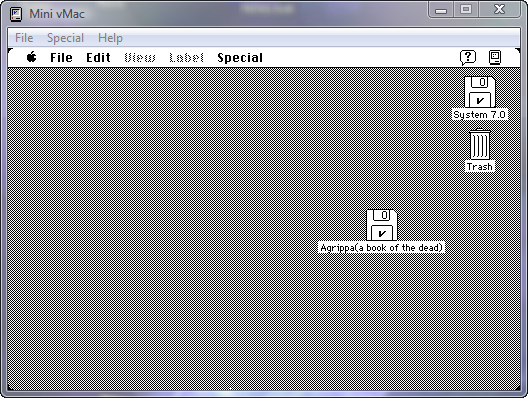
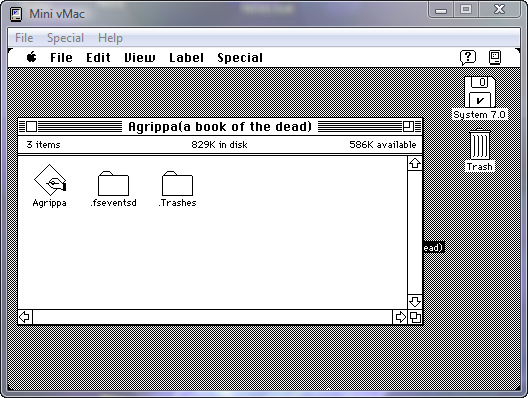
Process: » Disk image (bit-level copy) made using the “dd” copy process. (See Item #D50 on this site: downloadable disk-image file.) » Run of the disk-image copy on a computer using Mini vMac emulator with System 7 book disk (to emulate the functions of the original 1992 Mac platform for which the software on the diskette was created). » Video capture of the resulting run of the poem.
Editor’s Note: The following was contributed on July 17, 2011, by Freek Wiedijk, a mathematician and Assistant Professor of Computing and Information Sciences at Radboud Universiteit Nijmegen, The Netherlands.
I have been a long time fan of William Gibson, and was very excited about Agrippa when it appeared, long ago. At the time I was a Mac hacker. However, as I did not have access to the disk in the Agrippa art-book, I could not play with that. Of course I dutifully downloaded, read and stored the “Agrippa” poem once it was “hacked”, but that was it. (It took a long time before I had an idea what the book itself looked like, though.)
So recently I discovered The Agrippa Files site, and downloaded both the disk image and the movie of the Agrippa disk running in emulation.
So then I wondered whether I could have gotten the text of the poem out of that disk myself (without retyping it, just by hacking.) Of course my “classic Mac” skills are very rusty by now, but I still wanted to try. And I indeed did manage to “hack” Agrippa relatively easily, in a crude but effective way.
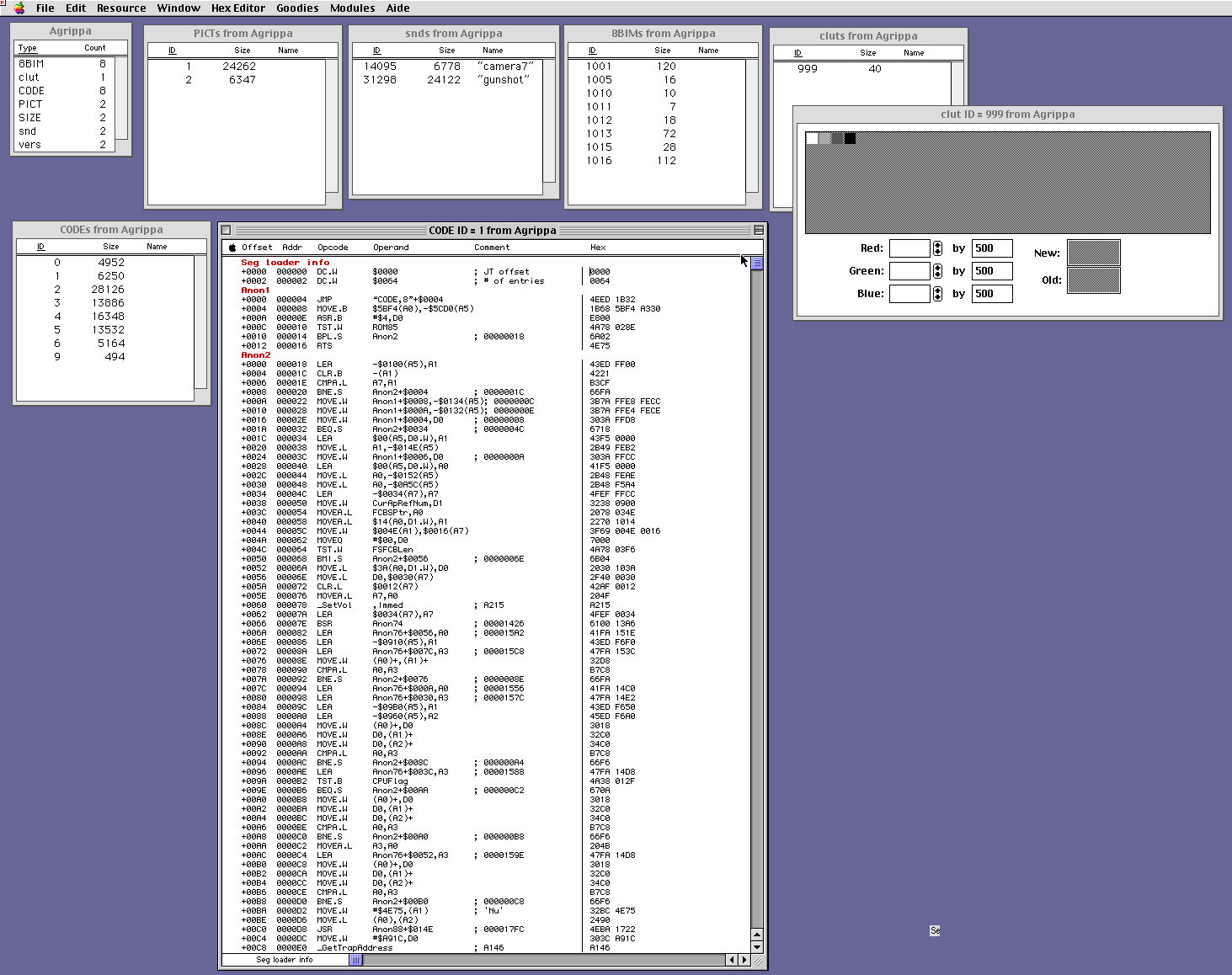
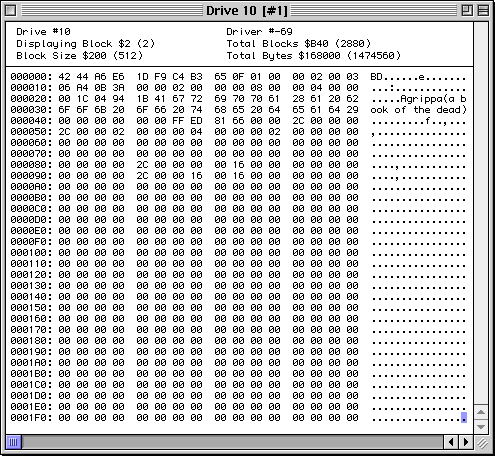
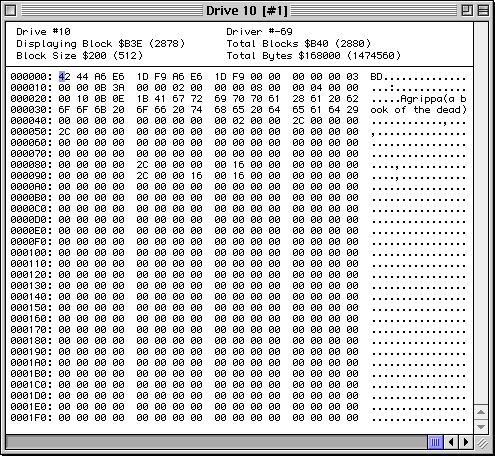
See also an independent technical analysis of the disk image performed by François Grieu, an engineer based in Paris (who also provided the screenshots, audio files, and other resources from his analysis at the left).
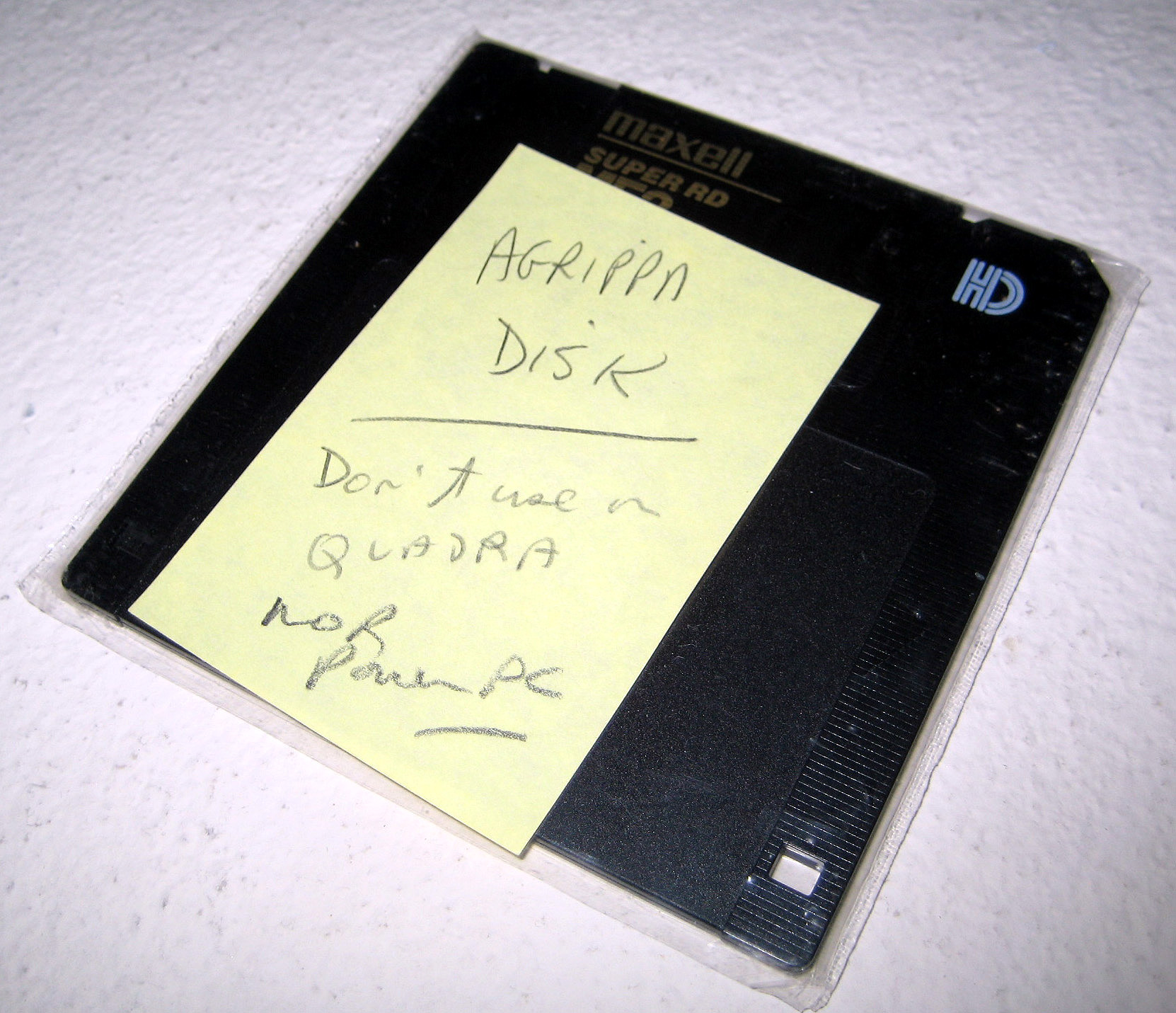
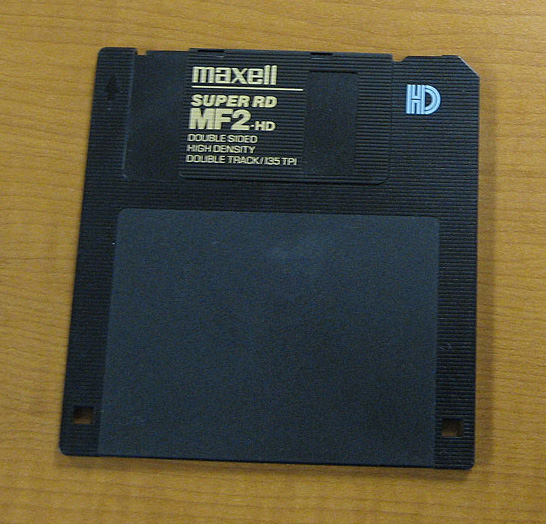
Item #D52. Original 1992 Agrippa 3½”, 1.4 Mb diskette belonging to collector Allan Chasanoff used to make the disk-image copy and emulated run of the William Gibson poem featured on this site.
This was the diskette used to create The Agrippa File’sdisk-image (bit-level) copy of William Gibson’s poem and its accompanying software, as well as the emulated run of the whole package. In the Digital Forensics Lab at the University of Maryland, College Park, multiple copies were spawned from the original diskette and run through a computer emulating the platform of a 1992-vintage Mac. Multiple instances of Gibson’s poem thus came back to life, ran, and died (disappeared at the hands of the disk’s included encryption program) in the effort to capture the experience of reading the original poem—the experience, that is, minus the sense of one-time-only uniqueness that was part of the core work.
The diskette was loaned by Allan Chasanoff from his copy of Agrippa (editioned “10/95”). Chasanoff’s copy of the book is part of a collection of “book art” he began aggregating in 1990 that has grown to 275 works. The theme of his collection is “the artist and the new ‘disrespect’ he had in opposition to the older cultural devotion to the integrity of the book” (email from Chasanoff to Alan Liu, 5 December 2008).
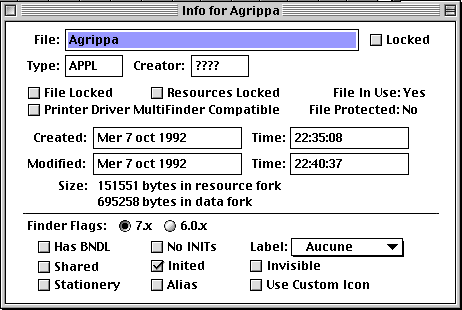
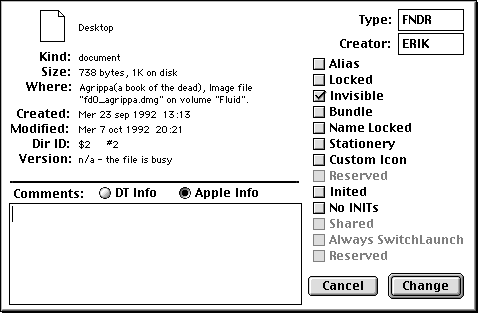
The creation date of the software on Chasanoff’s diskette is “Wed., Sept. 23, 1992, at 1:13 pm; Modified Wed., Oct. 7, 1992, 10:50 pm.” The Post-It note on the wrapper of the diskette is Chasanoff’s original note (apparently dating from the time of acquisition). For discussion of the digital forensics used to recover and run the software from this disk, see Matthew G. Kirschenbaum, with Doug Reside and Alan Liu, “No Round Trip: Two New Primary Sources for Agrippa.”
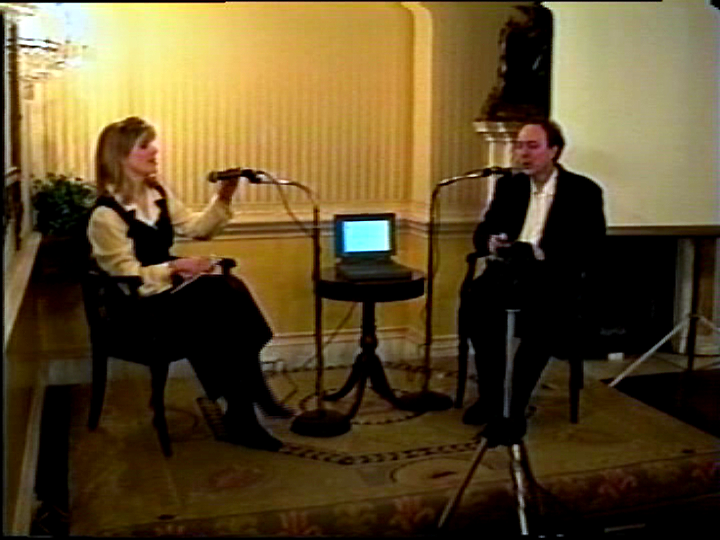
Item #D48. Bootleg Video of Live Run of the Diskette Containing William Gibson’s “Agrippa” at the Americas Society, New York City (9 Dec. 1992).
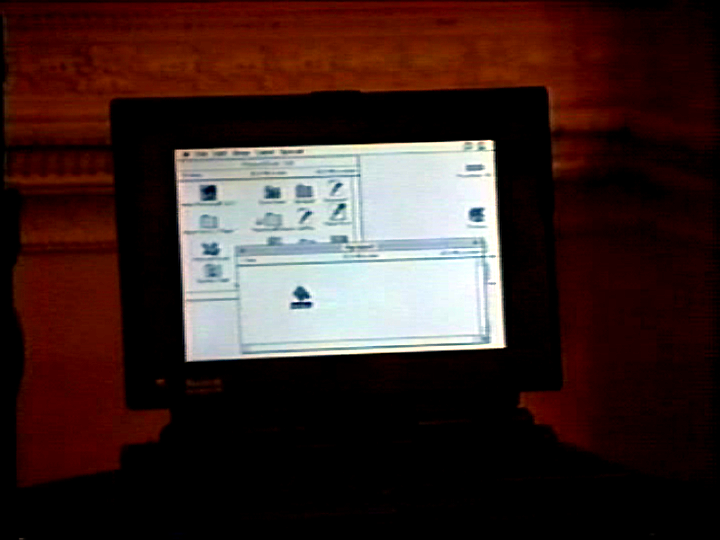
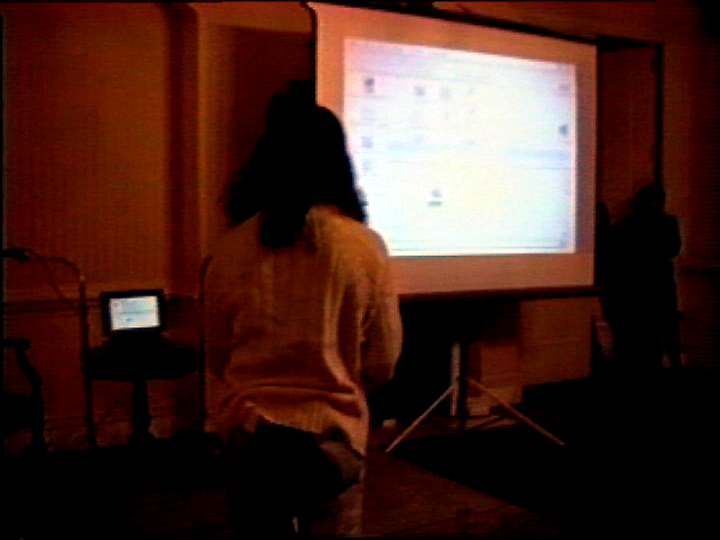
This video, approximately one hour long, was made surreptiously by “Templar,” the pseudonym of one member of a graduate-student team known as “Templar, Rosehammer, and Pseudophred” from New York University’s Interactive Television Program. The team had been recruited to shoot the screen of a laptop computer used by Kevin Begos, Jr. (the publisher of Agrippa) for the public unveiling of Agrippa at the Americas Society, New York City, on December 9, 1992 (during the so-called “Transmission” event). Their sanctioned mission was to project on a large screen the laptop’s image of a complete, live “run” of William Gibson’s poem (running from Agrippa’s diskette). Unbeknownst to the event’s organizers, however, Templar had slotted a blank video cassette into the camera used for the live feed. The resulting recording is presented here from a copy of the original videotape (the original has not been found) recovered in 2007 by “Rosehammer” from a ¾ video tape cartridge (in NTSC format) labeled “AGRIPPA—[Templar’s] VIEW.” Highlights of the recording include:
Interview of Kevin Begos, Jr. by Karen Benfield, producer for the Wall Street Journal Television Report (approx. 20 minutes).
The “run” of Gibson’s poem scrolling up the screen of Begos’s laptop, accompanied by a synchronized audio recording of comedian Penn Jilette reading the text (approx. 20 minutes).
Question and answer period with Begos, cut off unexpectedly when someone approached Templar and caused him to stop recording to prevent discovery.
For detailed discussion of this video and related events, see on this site Matthew G. Kirschenbaum’s “No Round Trip: Two New Primary Sources for Agrippa“ (as well as the earlier excerpt from his book, Mechanisms: New Media and the Forensic Imagination (MIT Press, 2008). Of related interest: Re:Agrippa, an experimental video composition made by Rosehammer and Templar in 1993 that samples and remixes selected footage from the 1992 bootleg video, and adds experimental-video-style montage, sound, and titling effects.
Note: The Agrippa Files had originally wanted to present this video on YouTube because it is the most iconic of the cyberspace, viral video channels now fulfilling the prophecy of Templar, Rosehammer, and Pseudophred’s “hack” of the Americas Society event on December 9, 1992, which led the next day to the viral, plain-text release of Gibson’s poem on the internet. But due to the length of the video, which exceeds YouTube’s constraints, Google Video was chosen.